

What Exactly is a Content Roadmap?
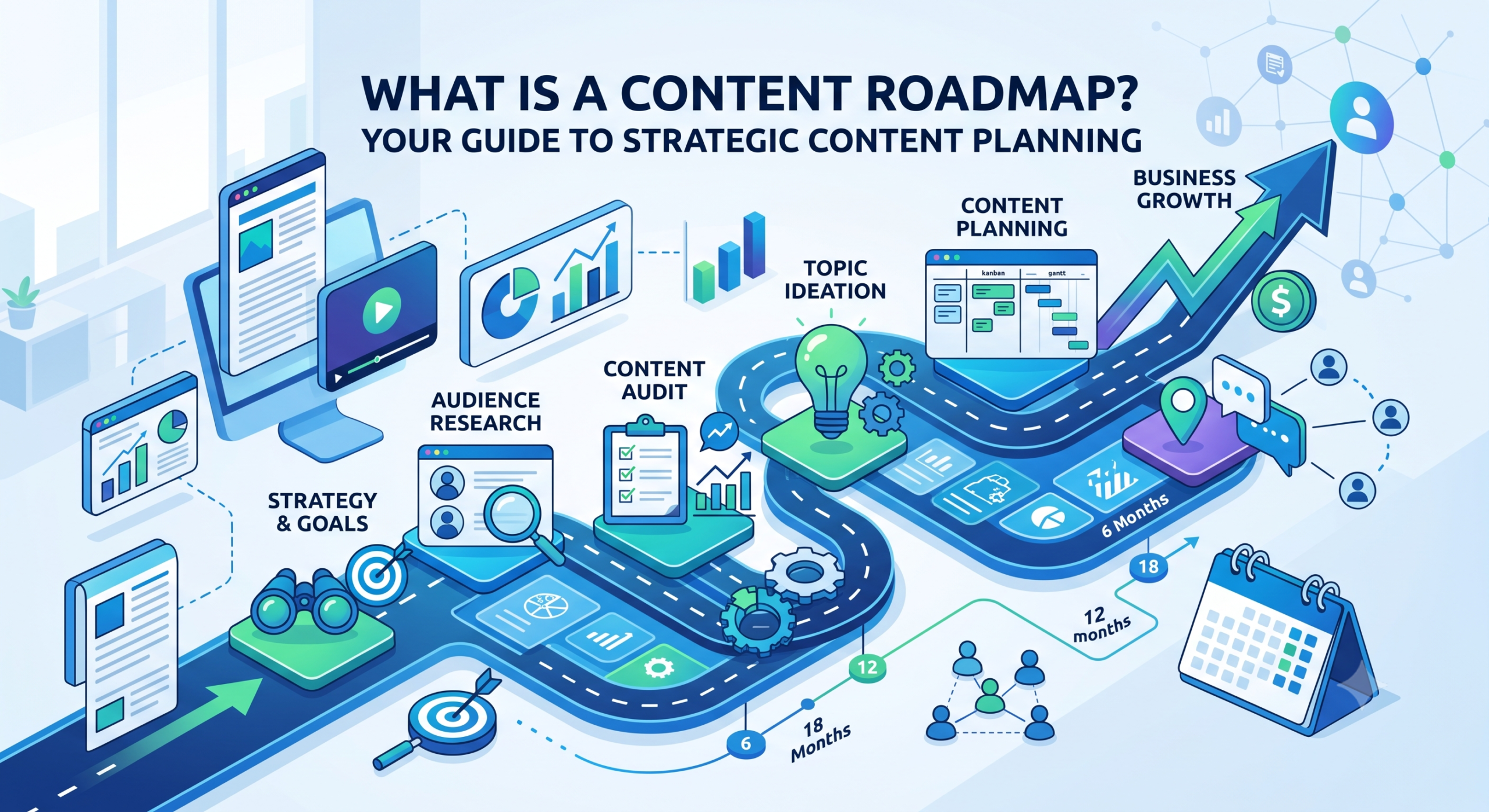
A content roadmap is a high-level strategic document that outlines the vision, goals, and key initiatives for your content over a defined period, typically 6–18 months. Unlike a simple list of upcoming posts, it provides a comprehensive view of your content ecosystem, connecting individual pieces to larger themes and business outcomes. It’s a living document that articulates the strategic direction for all content, ensuring every effort contributes meaningfully to your organization’s mission. This strategic approach is fundamental to effective content planning.
Beyond a Simple Content Calendar
While a content calendar is a tactical schedule detailing specific publication dates, topics, and assignments, a content roadmap operates at a higher, more strategic level. The roadmap defines the ‘why’ and ‘what’ over a longer term, setting the stage for the ‘when’ and ‘how’ that the calendar addresses. It focuses on strategic themes, audience segments, and business goals, providing the framework within which your daily or weekly content planning takes place. Think of the roadmap as the architectural blueprint for a building, and the calendar as the daily construction schedule.
Quick Comparison: Content Roadmap vs. Content Calendar
To keep your content operations running smoothly, it helps to understand how these two essential tools work side-by-side:
| Feature | Content Roadmap | Content Calendar |
|---|---|---|
| Primary Focus | Strategic direction, long-term vision, and business goals (“Why” & “What”) | Tactical execution, publication schedules, and task assignments (“When” & “How”) |
| Time Horizon | Long-term (6 to 18 months) | Short-term (Weekly, monthly, or quarterly) |
| Key Audience | Stakeholders, C-suite, marketing leads, and strategy teams | Content creators, copywriters, graphic designers, and editors |
| Flexibility | High-level and fluid; adapts to big business shifts and market trends | Structured and specific; tracks day-to-day deadlines and deliverables |
Connecting to Overall Content Strategy
The roadmap is the operational manifestation of your broader content strategy. It translates strategic objectives—such as increasing brand awareness, driving lead generation, or supporting customer retention—into tangible content initiatives. By mapping out content themes, formats, and distribution channels, the roadmap ensures that every piece of content aligns with your overall content marketing plan. It acts as a bridge between high-level business goals and the practical execution of content creation.
Why Your Organization Needs a Content Roadmap
Implementing a content roadmap offers significant advantages, enhancing efficiency, fostering alignment, and driving measurable results. These benefits of content roadmapping extend across various aspects of your content operations.
Aligning Content with Business Goals
A primary benefit of a content roadmap is its ability to ensure every content piece serves a specific purpose. It forces teams to consider how each blog post, video, or whitepaper contributes to larger organizational objectives, whether that’s increasing website traffic, improving conversion rates, or establishing thought leadership. This direct link between content and business outcomes is a cornerstone of a robust content strategy and a well-executed content marketing plan.
Enhancing Content Planning and Efficiency
Structured content planning, guided by a roadmap, significantly reduces wasted effort and resources. By outlining themes and initiatives in advance, teams can proactively identify content gaps, avoid duplication, and streamline workflows. This foresight allows for better resource allocation and more efficient execution throughout the entire content development process.
Improving the Content Development Process
A clear roadmap provides clarity for everyone involved in content creation—writers, designers, editors, and marketers. With a shared understanding of goals, target audiences, and key messages, the content development process becomes more cohesive. This leads to higher quality, more consistent content that resonates with the intended audience and supports effective content pipeline management.
Better Resource Allocation and Pipeline Management
By visualizing future content needs, a roadmap enables better forecasting of resource requirements. Teams can anticipate demands for specific skills, allocate budgets effectively, and manage the flow of content from ideation to publication. This proactive approach to content pipeline management ensures that content is produced on time, within budget, and to the required quality standards, optimizing overall content planning.
How to Build a Content Roadmap: A Step-by-Step Guide
Building an effective content roadmap involves a structured approach, moving from strategic foundations to tactical execution. Here is a practical, step-by-step roadmap creation process:
Step 1: Conduct a Content Audit (Assess What You Have)
Before deciding where you want to go, you need to understand where you currently stand. A thorough content audit helps you evaluate your existing assets to see what is working, what needs a quick refresh, and what should be retired altogether.
- Keep & Update: High-performing articles that need fresh statistics or minor SEO tweaks.
- Repurpose: Valuable long-form content (like whitepapers) that can be broken into blog posts or infographics.
- Prune: Outdated, irrelevant, or duplicate content that no longer aligns with your brand voice or goals.
Step 2: Define Your Content Strategy and Objectives
Articulate your overarching business goals clearly. Are you trying to boost customer retention, drive qualified leads, or expand brand awareness? Identify key performance indicators (KPIs) to measure success at every milestone. A well-defined content marketing plan relies heavily on these crystal-clear objectives.
Step 3: Audience Research and Keyword Identification
Thoroughly understand your audience’s needs, pain points, and interests. Conduct keyword research to identify the terms and questions they use to find solutions. This insight is crucial for effective content planning and helps determine what content will truly resonate across different target segments.
Step 4: Content Ideation and Prioritization
Brainstorm a wide range of content ideas that align with your objectives and audience research. Then, prioritize these ideas based on their potential impact, feasibility, and alignment with strategic themes. This step is critical for efficient content planning and optimizing the content development process.
Step 5: Mapping Content to the Marketing Funnel & Customer Journey
Your target audience goes through distinct stages before making a purchasing decision. Your content roadmap must provide valuable touchpoints at each stage of the marketing funnel:
- Awareness Stage (Top of Funnel – ToFu): Educational blog posts, infographics, and social media content designed to solve broad problems and attract initial interest.
- Consideration Stage (Middle of Funnel – MoFu): Comparison guides, case studies, and webinars that show how your product or service addresses specific pain points.
- Decision Stage (Bottom of Funnel – BoFu): Product demos, free trials, pricing guides, and customer testimonials that convert prospective buyers into clients.
- Retention & Loyalty Stage (Post-Purchase): User onboarding guides, video tutorials, and product updates to maximize customer satisfaction and lower churn.
Step 6: Establishing a Content Calendar and Production Schedule
Once high-level themes and initiatives are defined in the roadmap, translate them into a more detailed content calendar. Assign specific content pieces, set deadlines, and allocate responsibilities to your creation team. This tactical scheduling is vital for seamless pipeline management.
Step 7: Review, Iterate, and Adapt
A content roadmap is not carved in stone. Regularly review its performance against your KPIs, gather feedback from sales and support teams, and stay nimble. Being prepared to adapt your strategic direction ensures your content stays relevant even when market dynamics change.
Key Attributes of an Effective Content Roadmap
While every organization’s content roadmap looks a bit different depending on their goals, the most successful roadmaps always share four critical traits:
- Visual & Intuitive: It should provide a clear, high-level snapshot—whether set up as a flow chart, kanban board, or color-coded timeline—so anyone can grasp the strategy at a glance.
- Organized & Uniform: Every team member adding or updating initiatives should follow standard guidelines to prevent confusion and disjointed messaging.
- Accessible to All Stakeholders: It should be written in clear, jargon-free language so cross-functional teams, executives, and C-suite leaders can easily understand the vision.
- Fluid & Adaptable: Markets shift, product features update, and customer needs evolve. A strong roadmap remains flexible enough to pivot when real-time data points in a new direction.
Essential Tools for Building Your Content Roadmap
You don’t need complex software to get started, but using the right collaboration tools makes managing your content roadmap significantly easier:
- Notion & Airtable: Excellent for creating customizable, relational databases that bridge long-term strategic roadmaps directly with daily content calendars.
- Asana & Trello: Great visual tools for tracking initiatives across visual Kanban boards and timeline views.
- Miro & Lucidchart: Ideal for brainstorming visual flowcharts, customer journey maps, and content architecture during early strategy sessions.
- Google Sheets / Excel: Simple, accessible, and budget-friendly for small teams looking to build customized timeline matrices.
Content Roadmap Examples in Practice
To illustrate the versatility of a content roadmap, consider these practical content roadmap examples that demonstrate how different organizations apply this strategic approach to content strategy and content planning.
Product Launch Content Roadmap
For a new product launch, a roadmap might outline content phases: pre-launch (teasers, problem-solution content), launch (announcements, feature deep-dives), and post-launch (tutorials, customer testimonials). This ensures a coordinated content rollout that builds anticipation and supports the overall content marketing plan and content planning efforts.
Evergreen Content Strategy Roadmap
An evergreen content roadmap focuses on foundational, long-lasting content that consistently attracts and engages audiences over time. This could include comprehensive guides, ultimate lists, or core educational resources. The roadmap would plan for the creation, optimization, and regular updating of these assets, central to a sustainable content strategy and efficient content development process.
Campaign-Specific Content Planning
For a focused marketing campaign, a roadmap would detail all content assets required, from landing page copy and email sequences to social media posts and ad creatives. It ensures all content works together to achieve specific campaign goals, providing a clear framework for content planning and integrating seamlessly with the broader content marketing plan.
Integrating Your Content Roadmap with Your Content Marketing Plan
The content roadmap is not a standalone document; it’s a core component of your broader content marketing plan. It provides the strategic direction and long-term vision that informs all tactical content activities. By integrating the roadmap, you ensure that every piece of content, every campaign, and every channel contributes to a unified content strategy. This integration clarifies what is a content roadmap’s role: to translate strategic intent into actionable content initiatives, driving consistent brand messaging and measurable business growth.
Frequently Asked Questions about Content Roadmaps
What’s the difference between a content roadmap and a content calendar?
A content roadmap is a high-level, strategic document outlining content vision, goals, and major themes over a longer period (e.g., 6–18 months). It defines the ‘what’ and ‘why.’ A content calendar, conversely, is a tactical schedule that details specific content pieces, publication dates, and assignments for a shorter period (e.g., weeks or months). It focuses on the ‘when’ and ‘how.’ The roadmap provides the strategic framework for the calendar.
How often should a content roadmap be updated?
A content roadmap should be reviewed and updated regularly, typically quarterly or bi-annually. This frequency allows for adjustments based on performance data, market shifts, new business priorities, or changes in your content strategy. While the core vision might remain stable, the initiatives and timelines within your content planning should be flexible.
Can a small business benefit from a content roadmap?
Absolutely. Small businesses, perhaps even more so than larger enterprises, can significantly benefit from a content roadmap. It helps them maximize limited resources, maintain focus, and ensure every content effort contributes directly to their growth objectives. The benefits of content roadmapping, such as improved efficiency and goal alignment, are universal, regardless of business size.
Conclusion
A content roadmap is more than just an organizational tool; it’s a strategic imperative for any organization serious about its content efforts. By providing a clear vision, aligning content with business objectives, and streamlining the creation process, it transforms reactive publishing into a proactive, results-driven endeavor. Embracing a robust content strategy and meticulous content planning through a well-defined roadmap is fundamental to achieving sustained content success and realizing your marketing goals.