
Marketing has undergone a significant transformation, moving from broad, mass-market campaigns to increasingly refined and targeted approaches. What began with demographic segmentation evolved into behavioral personalization, aiming to deliver more relevant messages to specific customer groups. Today, the frontier of customer engagement is pushing beyond even advanced personalization, leading to a sophisticated methodology known as PI-specific marketing. This approach represents the pinnacle of individual customer understanding and interaction, leveraging deep insights to create truly unique experiences. But what is PI-specific marketing, and how does it redefine the relationship between brands and their audience?
Defining PI-Specific Marketing
At its core, PI-specific marketing is an advanced form of customer engagement that focuses on delivering highly relevant, predictive, and individual experiences. It moves beyond traditional segmentation and even basic personalization to anticipate individual customer needs and preferences in real-time. The PI marketing definition centers on leveraging comprehensive data and sophisticated analytics to create a marketing message or experience that is unique to a single customer at a specific moment.
The Core Concept of Individualized Marketing
The foundation of PI-specific marketing lies in the principle of individualized marketing. This concept posits that every customer is a unique entity with distinct behaviors, preferences, and needs. Instead of grouping customers into segments, even micro-segments, individualized marketing aims to treat each customer as a ‘segment of one.’ This means tailoring product recommendations, content, offers, and even the user interface of a website or app to match that specific individual’s journey and context. It’s about understanding not just who the customer is, but what they need and when they need it.
Hyper-Personalization: The Next Level of Engagement
While often used interchangeably, PI-specific marketing takes hyper-personalization marketing a step further. Hyper-personalization typically involves using real-time data to deliver highly relevant content or offers. PI-specific marketing builds on this by adding a predictive layer. It doesn’t just react to current behavior; it anticipates future actions and needs based on a vast array of historical and contextual data. This allows brands to proactively engage customers with solutions or information they haven’t even explicitly searched for yet, creating a more seamless and intuitive customer journey.
How PI Marketing Works: Mechanisms and Technology
Understanding how does PI marketing work involves delving into the sophisticated technological and data-driven processes that power it. It’s a complex ecosystem designed to process vast amounts of information and translate it into actionable, individual-level insights.
Data Collection and Advanced Analytics
The bedrock of PI-specific marketing is comprehensive data collection. This includes:
- Behavioral Data: Website clicks, browsing history, app usage, search queries, content consumption.
- Transactional Data: Purchase history, order frequency, average order value, returns.
- Demographic Data: Age, location, income (where available and permissible).
- Contextual Data: Device type, time of day, weather, current events.
- Preference Data: Explicitly stated preferences, wish lists, survey responses.
This raw data is then fed into advanced analytics platforms, often powered by artificial intelligence (AI) and machine learning (ML) algorithms. These algorithms identify patterns, predict future behaviors, and generate individual customer profiles that are constantly updated. The goal is to create a 360-degree view of each customer, enabling highly accurate predictions about their next likely action or need.
Real-time Adaptation and Dynamic Content Delivery
Once insights are generated, the next critical step in how does PI marketing work is the ability to translate these insights into immediate, relevant marketing actions. This requires dynamic content delivery systems that can adapt messages, offers, and experiences across various channels in real-time. For instance, if a customer is browsing a specific product category, the system might instantly adjust the website’s homepage, recommend complementary products, or trigger a personalized email with a relevant discount. This real-time adaptation ensures that every interaction is optimized for the individual, maximizing engagement and conversion potential.
Technical Architecture: Integrating CDPs, Vector Databases, and Predictive AI Engines
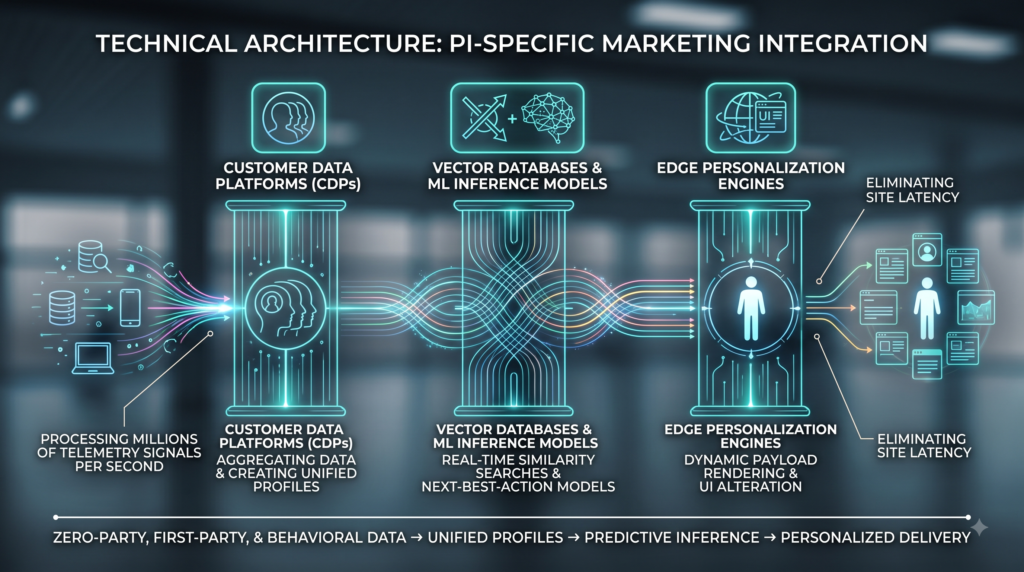
To execute true PI-specific marketing at enterprise scale, organizations rely on a sophisticated technical infrastructure. This architecture processes millions of telemetry signals per second and transforms raw events into real-time personalized delivery:
- Customer Data Platforms (CDPs): Platforms like Segment, ActionIQ, or Tealium serve as the central nervous system, aggregating zero-party, first-party, and behavioral data across disparate channels into unified persistent profiles.
- Vector Databases & ML Inference Models: High-dimensional embeddings and specialized vector databases allow machine learning engines to perform real-time similarity searches, mapping customer real-time behavior to Next-Best-Action (NBA) models within milliseconds.
- Edge Personalization Engines: Solutions such as Braze, Dynamic Yield, or custom API endpoints deliver dynamic payload rendering directly at the edge, eliminating site latency while altering UI components dynamically.
Crafting a PI Marketing Strategy
Developing an effective PI marketing strategy requires careful planning, robust technology, and a clear understanding of business objectives. It’s not merely about implementing a new tool but rethinking how customer relationships are built and nurtured.
Defining Objectives and Identifying Key Data Points
The first step in any successful PI marketing strategy is to define clear, measurable objectives. Are you aiming to increase customer lifetime value, reduce churn, boost conversion rates, or enhance customer satisfaction? Once objectives are set, identify the key data points necessary to achieve them. This involves auditing existing data sources, identifying gaps, and planning for new data collection methods. Prioritize data that directly informs individual customer behavior and preferences relevant to your goals.
Technology Stack and Implementation
A robust technology stack is indispensable for PI-specific marketing. This typically includes Customer Data Platforms (CDPs) to unify customer data, AI/ML-powered analytics engines, real-time personalization platforms, and marketing automation systems. Integration between these various tools is paramount to ensure seamless data flow and consistent customer experiences across all touchpoints. Implementing a PI strategy often involves a phased approach, starting with specific use cases and gradually expanding capabilities.
Overcoming the “Cold Start” Problem & Data Latency Bottlenecks
When deploying a PI marketing strategy, engineering and marketing teams frequently encounter operational hurdles that require specialized strategies:
- The Cold Start Problem: New or anonymous users lack historical transactional data, making predictive modeling difficult. Marketers mitigate this by deploying real-time contextual targeting (e.g., referral source, geolocation, and session behavior) alongside interactive zero-party data quizzes during onboarding to instantly seed initial profiles.
- Data Latency Bottlenecks: If streaming event data takes minutes to ingest into a CDP, the opportunity to deliver real-time personalized messaging vanishes. Implementing streaming data architecture like Apache Kafka or AWS Kinesis ensures sub-second data synchronization between user interactions and activation layers.
PI Marketing Examples in Action
To truly grasp the power of this approach, examining concrete PI marketing examples helps illustrate its practical application across diverse industries.
Retail and E-commerce Personalization
In retail, PI-specific marketing manifests through highly dynamic and predictive experiences. Consider an e-commerce site that not only recommends products based on past purchases but also anticipates future needs. For example, if a customer frequently buys baby products, the system might predict the next stage of their child’s development and proactively suggest age-appropriate items or content. Other PI marketing examples include personalized homepage layouts, dynamic pricing based on individual browsing behavior and loyalty status, or tailored email campaigns that offer discounts on items the customer has shown interest in but not yet purchased, factoring in their typical buying cycle.
Financial Services and Healthcare Applications
Beyond retail, PI-specific marketing offers significant value in sectors like financial services and healthcare. A financial institution might use PI to offer customized financial advice, suggesting specific investment products or savings plans based on an individual’s spending habits, life stage, and stated financial goals. In healthcare, PI could involve personalized health recommendations, such as suggesting preventative screenings based on an individual’s health history, lifestyle data, and genetic predispositions (with appropriate consent and privacy safeguards). These PI marketing examples highlight the ability to deliver highly sensitive and critical information in a relevant and timely manner.
Benefits of PI Marketing for Businesses and Customers
The adoption of PI-specific marketing yields substantial benefits of PI marketing for both the organizations implementing it and the customers they serve.
Enhanced Customer Experience and Loyalty
For customers, PI-specific marketing translates into a significantly enhanced experience. They receive more relevant communications, encounter fewer irrelevant offers, and feel understood by the brand. This leads to increased satisfaction, stronger emotional connections, and ultimately, greater customer loyalty. When interactions are consistently helpful and tailored, customers are more likely to return and advocate for the brand.
Improved ROI and Operational Efficiency
Businesses realize several tangible benefits of PI marketing. By targeting individuals with precision, marketing spend becomes far more efficient, leading to improved return on investment (ROI). Wasted impressions and irrelevant campaigns are minimized. Furthermore, the predictive nature of PI allows for better inventory management, optimized resource allocation, and more effective sales forecasting, contributing to overall operational efficiency.
PI Marketing vs. Personalized Marketing: A Key Distinction
While often conflated, understanding the difference between personalized marketing vs PI marketing is crucial for appreciating the advanced nature of the latter.
Personalization: Segment-Based Approaches
Traditional personalized marketing, while effective, often operates on segment-based approaches. It groups customers into categories based on shared characteristics (e.g., demographics, past purchases, browsing behavior) and then tailors content or offers to those segments. For instance, all customers who bought product X might receive an email about product Y. This is a significant improvement over mass marketing but still treats groups of customers similarly, rather than as unique individuals.
PI: Real-time, Predictive, and Individual-Centric
In contrast, PI-specific marketing is fundamentally real-time, predictive, and individual-centric. It moves beyond static segments to create a dynamic, evolving profile for each customer. The distinction in personalized marketing vs PI marketing lies in PI’s ability to not only react to current data but to anticipate future needs and behaviors. It leverages advanced AI to understand the nuances of an individual’s journey, offering truly individualized marketing experiences that are proactive rather than reactive. This level of foresight and precision is what elevates PI-specific marketing beyond even advanced forms of hyper-personalization marketing.
Comparison Framework: Evolution of Marketing Personalization
| Feature | Traditional Marketing | Segmented Personalization | Hyper-Personalization | PI-Specific Marketing |
| Target Granularity | Broad demographics | Audience segments | Micro-segments | Segment of One (Individual) |
| Data Usage | Static survey / census data | Historical purchase data | Real-time behavioral signals | Unified multi-source + zero-party |
| Execution Speed | Batch campaigns | Scheduled automated emails | Real-time trigger alerts | Instantaneous predictive UI adaptation |
| Core Mechanism | Static rule sets | If-Then workflow logic | Rules-based dynamic engines | Predictive Machine Learning & AI |
Frequently Asked Questions about PI-Specific Marketing
What is the primary difference between PI marketing and traditional personalization?
The primary difference in personalized marketing vs PI marketing is the level of granularity and prediction. Traditional personalization often targets segments of customers based on shared attributes. PI marketing, however, focuses on the individual, using real-time data and predictive analytics to anticipate specific needs and deliver unique, proactive experiences to a ‘segment of one.’
Is PI marketing only for large enterprises?
While large enterprises with extensive data resources were early adopters, advancements in AI and cloud-based platforms are making a PI marketing strategy more accessible to businesses of various sizes. Scalable solutions now allow smaller and medium-sized businesses to implement aspects of PI, focusing on specific customer journeys or high-value interactions.
What are the main challenges in implementing a PI marketing strategy?
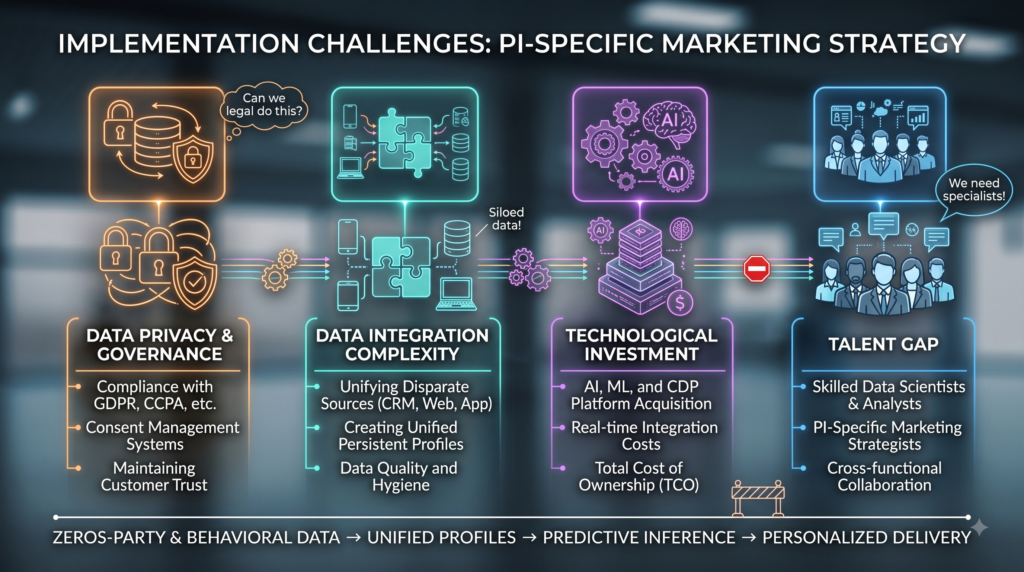
Implementing a PI marketing strategy presents several challenges, including:
- Data Privacy and Governance: Ensuring compliance with regulations like GDPR and CCPA, and maintaining customer trust.
- Data Integration Complexity: Unifying data from disparate sources into a single, actionable customer view.
- Technological Investment: Acquiring and integrating the necessary AI, ML, and CDP platforms.
- Talent Gap: Needing skilled data scientists, analysts, and marketing strategists to manage and optimize the system.
How does PI-specific marketing remain compliant with strict data privacy laws like GDPR and CCPA?
PI marketing relies heavily on first-party and zero-party data obtained through explicit customer consent rather than invasive third-party tracking. By giving users direct control over their data preferences through consent management tools and maintaining strict data governance frameworks, brands can deliver individualized experiences ethically and lawfully.
Conclusion: The Future is Individualized
PI-specific marketing represents a significant leap forward in how brands connect with their customers. By moving beyond broad strokes and even advanced segmentation, it enables a level of individualized engagement that was once unimaginable. The ability to understand, anticipate, and respond to each customer’s unique journey in real-time offers profound benefits of PI marketing, from enhanced customer loyalty and satisfaction to improved operational efficiency and ROI. As technology continues to evolve, what is PI-specific marketing today will become the standard for tomorrow, solidifying the future of marketing as truly individualized.