

A marketing manager plays a pivotal role in shaping a company’s brand presence and driving business growth. This position demands a unique blend of creativity, analytical prowess, and leadership, making it a cornerstone of any successful organization. Understanding the intricacies of this dynamic role is essential for anyone aspiring to a career in marketing or seeking to collaborate effectively with marketing teams. This article explores the core functions, necessary skills, career progression, salary expectations, and various specializations within the marketing manager profession.
What Does a Marketing Manager Do?
The primary function of a marketing manager is to oversee and execute marketing strategies that promote a company’s products or services. This involves a broad spectrum of activities aimed at attracting, engaging, and retaining customers. The overarching goal is to enhance brand visibility, generate leads, and ultimately contribute to revenue growth.
Core Marketing Manager Responsibilities
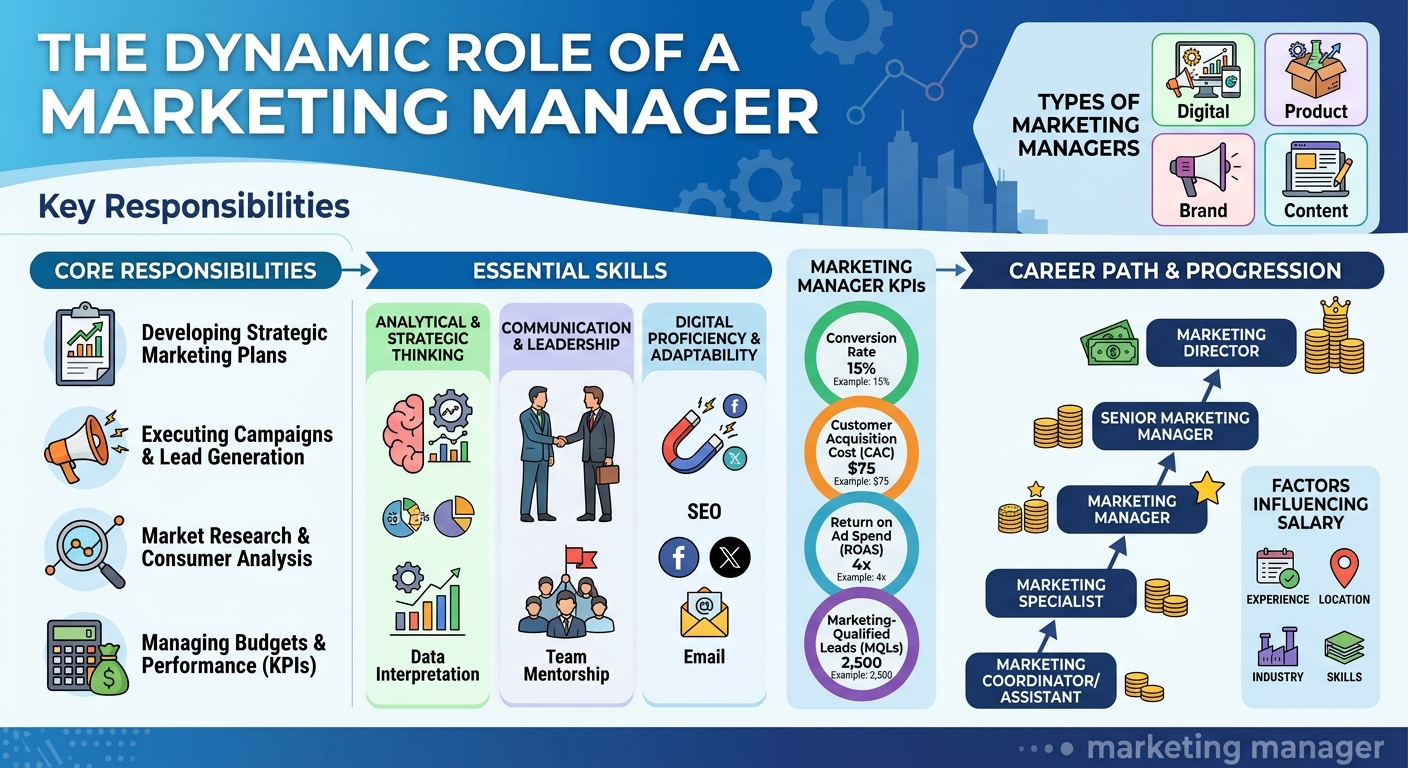
The marketing manager responsibilities are diverse and critical to business success. These professionals are typically tasked with developing comprehensive marketing plans aligned with business objectives. This includes identifying target audiences, conducting market research to understand consumer behavior and competitive landscapes, and defining key messaging. They manage marketing campaigns across various channels, from digital platforms to traditional media, ensuring consistent brand communication. Furthermore, a significant part of their role involves budget management, performance tracking, and leading a team of marketing specialists to achieve departmental goals.
Daily Tasks and Strategic Oversight
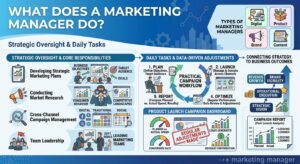
A typical day for a marketing manager might involve analyzing campaign performance data, collaborating with sales and product development teams, or brainstorming new promotional initiatives. They provide strategic oversight for all marketing initiatives, ensuring that campaigns are not only creative but also data-driven and effective. This includes monitoring KPIs (Key Performance Indicators), making data-backed adjustments to ongoing campaigns, and reporting on results to senior management. Their work bridges the gap between strategic vision and practical implementation.
Practical Example: Managing a Marketing Campaign
A practical marketing manager workflow can be illustrated through a product-launch campaign. The manager first defines the business objective and target audience, then selects appropriate channels, assigns responsibilities, establishes a budget, and chooses measurable KPIs. During the campaign, performance data is reviewed regularly so that underperforming messages, audiences, or channels can be adjusted. After the campaign, the manager documents results and lessons learned to improve future planning.
For example, a campaign report might compare planned and actual spend, leads or conversions generated, conversion rate, customer acquisition cost, and revenue contribution. This approach demonstrates how marketing management connects strategic planning with measurable business outcomes.
Essential Marketing Manager Skills
Success as a marketing manager requires a robust set of competencies that span analytical, interpersonal, and technical domains.
Analytical and Strategic Thinking
Effective marketing manager skills include a strong capacity for analytical and strategic thinking. Professionals in this role must be adept at interpreting market data, consumer insights, and campaign metrics to identify trends and opportunities. They use this information to formulate effective marketing strategies that address business challenges and capitalize on market potential. This involves forecasting, competitive analysis, and strategic planning.
Marketing Manager KPIs: Measuring Campaign Performance
Marketing managers use key performance indicators (KPIs) to evaluate whether marketing activity is achieving its intended objectives. The appropriate metrics depend on the campaign and business model, but commonly reviewed measures can include:
Conversion rate: the percentage of users who complete a defined desired action.
Customer acquisition cost (CAC): the cost associated with acquiring a customer.
Return on ad spend (ROAS): revenue attributed to advertising relative to advertising spend.
Marketing-qualified leads (MQLs): prospects that meet an organization’s defined marketing qualification criteria.
Customer lifetime value (CLV): an estimate of the value a customer generates over the relationship with a business.
A strong marketing manager does not rely on one metric in isolation. Performance should be interpreted in the context of campaign objectives, attribution methods, customer journey stage, and the quality of the resulting leads or customers.
Communication and Leadership
Clear and persuasive communication is paramount. A marketing manager must effectively articulate marketing strategies and campaign objectives to their team, stakeholders, and external partners. Strong presentation skills are essential for conveying ideas and results. Furthermore, leadership abilities are crucial for motivating and guiding a marketing team, fostering a collaborative environment, and ensuring projects are completed efficiently and to a high standard.
Digital Proficiency and Adaptability
Given the rapid evolution of marketing channels, digital proficiency is a non-negotiable skill. This includes understanding SEO, SEM, social media marketing, email marketing, content management systems, and marketing automation tools. Beyond technical knowledge, adaptability is key. A successful marketing manager must stay informed about emerging technologies and industry trends, readily adjusting strategies to remain competitive and relevant.
How to Become a Marketing Manager
The path to becoming a marketing manager typically involves a combination of education, practical experience, and continuous professional development.
Educational Background and Qualifications
Most marketing managers hold a bachelor’s degree in marketing, business administration, communications, or a related field. Some pursue a master’s degree, such as an MBA with a marketing specialization, to enhance their strategic and leadership capabilities. Relevant certifications in digital marketing, project management, or specific marketing platforms can also significantly aid career progression and demonstrate specialized knowledge.
Gaining Experience and Building a Portfolio
Entry-level roles such as marketing coordinator, marketing specialist, or assistant brand manager provide foundational experience. Internships during academic studies are invaluable for gaining practical exposure. To advance along the marketing manager career path, individuals should actively seek opportunities to lead projects, manage campaigns, and demonstrate measurable results. Building a portfolio of successful campaigns and initiatives is crucial for showcasing capabilities.
Continuous Learning and Professional Development
The marketing landscape is constantly changing, making continuous learning vital. Staying updated with new technologies, marketing trends, and industry best practices through workshops, online courses, and industry publications is essential for long-term success as a marketing manager. Networking with peers and mentors also provides valuable insights and opportunities.
Marketing Manager Career Progression: From Coordinator to Leadership
Career paths vary by organization and industry, but a common progression moves from execution-focused roles toward broader ownership of strategy, budgets, people, and business outcomes.
Marketing Coordinator or Assistant: supports campaigns, content, reporting, scheduling, and day-to-day marketing operations.
Marketing Specialist: develops deeper expertise in an area such as digital marketing, content, SEO, paid media, email, or events.
Marketing Manager: owns campaigns or marketing programs, coordinates cross-functional work, manages budgets, and evaluates performance.
Senior Marketing Manager: takes responsibility for larger programs, more complex strategies, and broader business objectives.
Marketing Director: oversees wider departmental strategy, larger budgets, teams, and organizational priorities.
Progression is not determined by job title alone. Demonstrating measurable campaign results, strong cross-functional communication, sound budget decisions, and the ability to turn data into action can strengthen a professional portfolio.
Marketing Manager Salary Expectations
The marketing manager salary can vary significantly based on several factors, reflecting the demand and complexity of the role.
Factors Influencing Marketing Manager Salary
Key factors influencing compensation include years of experience, geographic location, the industry sector (e.g., tech, healthcare, consumer goods), company size, and the specific skill set possessed by the individual. Specialized skills, such as expertise in data analytics, specific digital marketing platforms, or international marketing, can command higher salaries. Performance-based bonuses and other benefits also contribute to the overall compensation package.
Typical Salary Ranges by Experience Level
While specific figures fluctuate, entry-level marketing professionals typically earn a foundational salary, which increases substantially with experience. Mid-career marketing manager roles, often with 5-10 years of experience, see a significant rise in compensation. Senior marketing managers, including those in director or VP roles, command the highest salaries, reflecting their extensive experience, strategic impact, and leadership responsibilities.
How to Evaluate a Marketing Manager Salary Offer
Salary comparisons are most useful when they consider the complete compensation package rather than base pay alone. Candidates can compare base salary, performance bonuses, equity where applicable, benefits, location, expected responsibilities, team size, budget ownership, and opportunities for professional development.
Because compensation varies substantially by market and employer, current salary figures should be checked against reputable labor-market or compensation sources for the relevant country, location, industry, and experience level before making career decisions.
Types of Marketing Managers
The broad field of marketing has led to various specialized types of marketing managers, each focusing on distinct areas.
Digital Marketing Manager
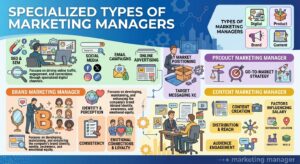
A Digital Marketing Manager specializes in online channels. Their responsibilities include overseeing SEO (Search Engine Optimization), SEM (Search Engine Marketing), social media marketing, email marketing campaigns, and online advertising. They focus on driving online traffic, engagement, and conversions through digital strategies.
Product Marketing Manager
A Product Marketing Manager focuses on bringing products to market. They understand customer needs, position products effectively, and develop messaging that resonates with target audiences. Their role often involves close collaboration with product development, sales, and public relations teams.
Brand Marketing Manager
The Brand Marketing Manager is responsible for developing and maintaining a company’s brand identity, awareness, and perception. They ensure brand consistency across all marketing efforts and work to build strong emotional connections with consumers, enhancing brand loyalty and equity.
Frequently Asked Questions About the Marketing Manager Role
Is a marketing manager a good career?
Yes, it is often considered a rewarding career path for individuals who enjoy strategic thinking, creativity, and leadership. The role offers opportunities for significant impact on business success and continuous professional growth.
What is the difference between a marketing manager and a marketing director?
A marketing manager typically focuses on executing specific marketing strategies and managing campaigns, often leading a small team. A marketing director holds a more senior position, overseeing the entire marketing department, setting broader strategic goals, managing larger budgets, and reporting directly to executive leadership.
What industries hire marketing managers?
Virtually all industries that offer products or services to consumers or businesses hire marketing managers. This includes technology, healthcare, finance, retail, consumer goods, entertainment, non-profit organizations, and many more.
Professionals can demonstrate experience through internships, freelance projects, volunteer campaigns, personal marketing projects, certifications, and documented case studies. The strongest examples explain the problem, the action taken, the reasoning behind the approach, and the measurable outcome.
How Can a New Marketing Manager Demonstrate Experience?
A useful portfolio can include selected campaigns, the objective for each project, the target audience, channels used, the manager’s responsibilities, key decisions, measurable results, and lessons learned. Where confidential business information is involved, results can be presented using approved or anonymized figures.
Conclusion
The role of a marketing manager is multifaceted and indispensable for modern businesses. It demands a blend of strategic vision, analytical skills, leadership, and adaptability to navigate the complexities of market dynamics and consumer behavior. For those with a passion for driving growth and connecting with audiences, a career as a marketing manager offers significant opportunities for professional fulfillment and impact.